When you want to purchase something, the market typically offers you a wide range of different options. This is one of the benefits of technological advancement. However, with so many options to consider, it can be overwhelming and time-consuming.
For instance, when you need a home UV light lamp for treating vitiligo/psoriasis, your dermatologist might tell you that 308nm is more effective than 311nm. However, he might not inform you that 308nm also comes in 308nm excimer and 308nm LED, two versions.
So, when faced with the question: 308nm excimer or 308nm LED? If you’re considering making a prudent and rewarding investment, you’ll need to brainstorm: Which one is best for me, and which brand can I afford?
We try to provide a comprehensive analysis of how different types of users can make the wisest choices when using a 308nm home light lamp, considering factors such as the instrument’s working principle, its effectiveness, cost-benefit ratio, and the current state of individual skin lesions.
What’s 308nm UV
Research has shown that among the ultraviolet spectrum, 308nm UV light is the gold-standard narrow-band medium-wavelength UV that can induce the killing of T cells and activate melanocytes.
Both psoriasis and vitiligo are fundamentally characterized by immune system dysfunction, with T cells mistakenly attacking the skin cells (or melanocytes) themselves.
308nm can very precisely and effectively induce these overactive T cells to commit suicide (apoptosis), thereby fundamentally suppressing the lesions.
For vitiligo, activating the melanocytes within the user’s hair follicles is crucial for restoring the skin to its original color.
Scientists have indicated that both 311nm and 308nm are narrow-band medium-wavelength ultraviolet rays, both of which are relatively safe for treating conditions like vitiligo and psoriasis.
However, 308nm clearly has higher energy and greater targeting capabilities, which means it tends to produce better treatment outcomes. In recent years, according to official user data, more and more users have increasingly favored 308nm UV light lamps.
What’s 308nm Excimer and 308nm LED
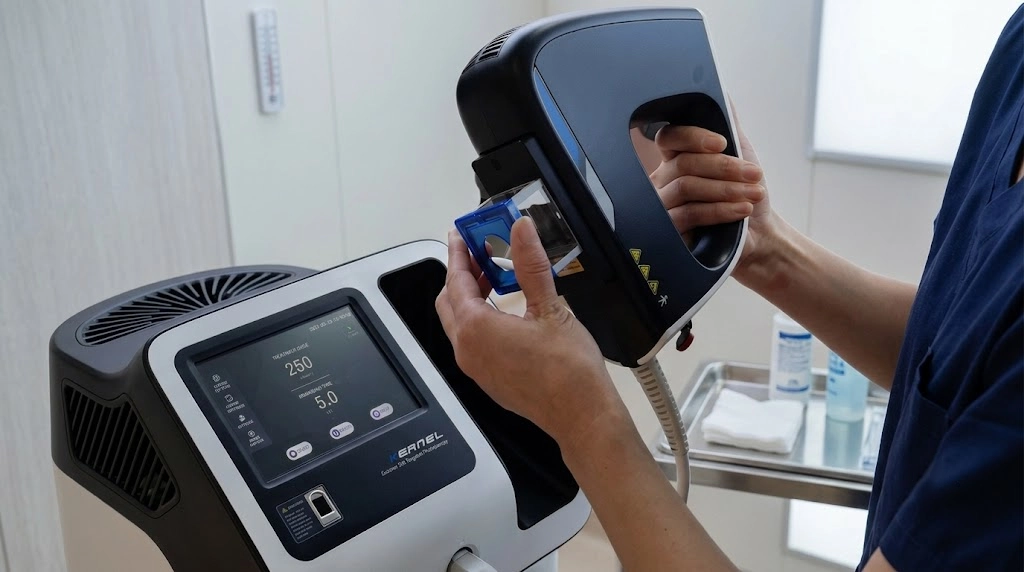
Both the 308nm excimer and the 308nm LED emit 308nm narrow-band medium-wavelength ultraviolet light. However, they do so through different physical mechanisms.
Excimer light source:
Produced by exciting xenon chloride (XeCl) gas under high pressure, its energy density is extremely high, and it has strong targeted penetration capabilities for the skin. For stubborn thickening lesions, the effects are often faster than those of LEDs.
However, due to the unique nature of its light source, excimer phototherapy devices often have a limited lifespan. The typical lifespan of ordinary household excimer phototherapy devices on the market is around 500 hours.
More expensive phototherapy devices may have a lifespan longer than 500 hours, but they also have an ultimate lifespan. Once the light source is depleted, the user is unable to replace it with a new one; they must instead purchase a new device.
LED Light Source:
Utilizes third-generation semiconductor chips for illumination. These chips are compact, have strong temperature control capabilities, and have an exceptionally long lifespan. A single phototherapy device can almost accompany the user throughout the entire treatment course (except in special cases).
LEDs produce low heat and emit light evenly. The incidence of side effects such as erythema, blisters, and other side effects on the user’s skin is significantly lower compared to excimer light. However, this also means that LED lamps take longer to produce results compared to excimer lamps.
Common home LED UV light lamps on the market typically have a lifespan of over 3,000 hours, which is sufficient for most users’ treatment needs.
However, for users with multiple lesions that recur frequently, a single device may not be enough, or the energy intensity of the chips may decrease over time, reducing the effectiveness of the treatment. In such cases, the user may need to consider purchasing a new phototherapy device.
308nm Excimer vs 308nm LED
To help you better understand the differences between home-use 308nm excimer and 308nm LED phototherapy devices, we have created a concise table outlining the key features, advantages, and disadvantages of each type of device.
Note: This comparison is solely a relative comparison between the two entities.
| Deep Dive | Home 308nm Excimer Lamp | Home 308nm LED Lamp |
| Energy Intensity | ★★★★★ | ★★★★ |
| Targeted Exposure | ★★★★★ | ★★★ |
| Life Span | ★★ about 500h | ★★★★★ ≥3000h |
| Use Convenience | ★★★★★ | ★★★★★ |
| Time to Effect | ★★★★ | ★★★ |
| Side-effect Possibility | ★★★★ | ★★★ |
| Cost-effectiveness | ★★★★ | ★★★★★ |
308nm Excimer or 308nm LED
With the advancement of technology and increasing market competition within the industry, in order to gain greater market advantages, professional manufacturers have long since upgraded traditional, simple phototherapy devices to more sophisticated, multifunctional, and user-friendly models.
Typically, 308nm UV light lamps are more expensive than 311nm lamps. However, users can purchase a 308nm LED home phototherapy device with timer function, energy intensity adjustment, and FDA certification for less than $500.
So, how should one choose among the numerous lamps available on the market? To address this question, we need to keep one point in mind: both 308nm excimer and 308nm LED are widely recognized as gold-standard phototherapy solutions for treating vitiligo and psoriasis.
Therefore, the choice between the two will not affect one’s ultimate treatment outcome.
Once we have addressed this point, we need to consider the following factors:
Lamp Compliance:
This pertains to the safety of usage. Non-compliant phototherapy devices are prone to short circuits during phototherapy, posing a risk of burning the skin.
There is also a risk of impure light sources and incorrect ultraviolet wavelengths, which, once present, can pose a certain carcinogenic risk to the user’s skin over an extended period.
Such consequences can be highly detrimental. To avoid this situation, users should verify beforehand whether the manufacturer of the home phototherapy device is a legitimate professional producer and whether the device has obtained FDA registration certification. While we do not entirely dismiss the ineffectiveness of UV light lamps that have not yet obtained FDA certification, we firmly affirm the reliability of those that have.
Cost-effectiveness:
This factor is primarily determined by the user’s personal budget and the functionality and lifespan of the UV light lamp itself. If you are not concerned about the lifespan of the phototherapy device and have sufficient budget to purchase a new one, and you simply seek better and faster results, such as in cases where the lesions are very noticeable and severe, then the 308nm excimer would be an excellent choice. If you want to purchase a single phototherapy device that can be used throughout its lifespan and are not in a hurry to see immediate treatment results, the 308nm LED would be a better option.
Skin Type:
As we discussed earlier, the 308nm excimer light source has greater energy intensity, but its side effects (erythema reaction, blistering) will also be more pronounced.
Typically, users who plan to purchase a home UV light lamp have already had experience with phototherapy at a dermatologist’s office and have undergone tests for erythema reactions.
Therefore, it is essential to make a careful decision when choosing a UV light lamp based on one’s past reactions to phototherapy. If one’s skin is particularly sensitive and reacts strongly to ultraviolet light, it is advisable to prioritize a comparatively mild 308nm LED.
Lesion Size:
Although the UV rays used in professional UV light therapy lamps have been filtered to remove the harmful components for human use, prolonged exposure can still have certain side effects on the skin.
Therefore, it is essential to choose a light therapy lamp that matches the size of the user’s own lesion. Modern 308nm light therapy lamps on the market come with various types of lamp covers, enabling users to achieve more precise, safe, efficient, and convenient personal light therapy.
Where You Can Buy One
Based on our market research, we have found that all 308nm light lamps are compact in design. Unlike traditional, cumbersome panel-style fluorescent NB-UVB lamps, these compact models are easier to carry around.
This innovative design allows users to enjoy phototherapy without being restricted by time or location, providing users with great convenience while allowing them to take control of their skin treatment process.
If you need one, please click [here] to choose the UV light therapy lamp that suits you. Whether what you need is a large or small lamp, inside of big or small budget, 308nm LED or 308nm excimer, you can find it here. Almost all the lamps listed in this link have received CE or FDA certification. They are manufactured by a professional manufacturer Kernel which specialized in phototherapy for over 30 years. So, just pick it!